
 EN
Final Article: How to Choose the Right Magnetic Stirrer Bar for Lab Use
A magnetic stirrer bar might look like a small consumable item, but it directly affects mixing stability, sample handling accuracy, and how much time technicians waste rescuing failed vortexes. From a laboratory equipment procurement perspective, the most important question is never simply "Which bar is the biggest?" Instead, success depends on whether the bar, vessel, liquid, and stirrer drive function together as one seamless system.
A rotating magnetic field beneath the vessel drives the immersed bar. When that magnetic coupling remains steady, mixing stays quiet and repeatable. When it fails, the bar rattles, decouples, or creates an uneven vortex. Selecting the right magnetic stirrer bar is therefore a conditional choice based on specific application details rather than a random catalog pick.
Start with the Mixing Job Rather Than Catalog Photos
Before comparing shapes or coatings, write down four essential basics: the working volume, the vessel type, the liquid viscosity, and the stirrer plate being used. These factors are closely connected. A short bar works wonderfully for a small, low-viscosity sample, while a larger vessel or thicker liquid requires a different length, shape, or a stronger drive magnet.
At first glance, choosing a magnetic stirrer bar seems to be only about matching its length to the container. In reality, vessel-bottom geometry and coupling strength matter just as much. A tall narrow flask, a round-bottom vessel, and a flat beaker never present the same mixing conditions.
Match Bar Length to Vessel Diameter and Working Volume
Use the vessel's inside diameter as the starting point, then confirm performance with the actual liquid. A bar that is too short produces a weak vortex and leaves slow-moving zones near the vessel wall. Conversely, a bar that is too long is harder to center, strikes curved walls, and loses stable coupling at higher speeds.
-
Small vessels and low volumes: A compact magnetic stirrer bar is usually much easier to control and far less likely to jump around.
-
Medium beakers and flasks: Select a length that sweeps a meaningful portion of the vessel bottom without getting too close to the wall.
-
Large volumes: Check the plate's stated mixing capacity and magnet strength before increasing bar size. A larger bar cannot compensate for an underpowered drive.
Stable coupling relies heavily on the vessel, liquid, stirrer drive, and bar profile working in harmony. For a repeatable purchasing specification, record the vessel family and working-volume range beside each bar size. That approach is far more practical than treating a single size as a universal laboratory standard.
Choose a Shape That Fits the Vessel and Flow Pattern
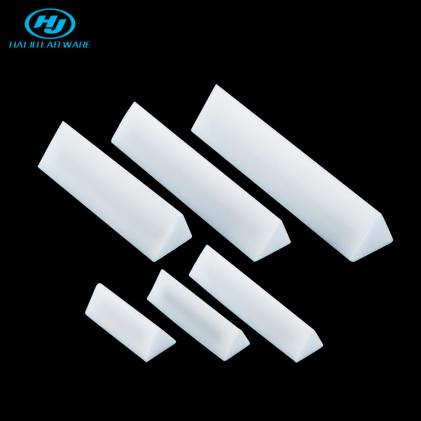
Shape alters how a magnetic stirrer bar follows the rotating field and moves liquid. Cylindrical or pivot-ring styles serve as practical general-purpose options for flat-bottom vessels. Octagonal styles increase surface interaction and work best when stronger mixing action is needed. Cross, triangular, or specialized profiles suit unique vessel geometries, but they should always be tested with the actual plate and container.
Neither option is universally better. If smooth, quiet operation in a flat-bottom beaker matters most, stable centering is the primary factor to evaluate. If breaking up a demanding flow pattern is the priority, testing whether the shape stays coupled at high speeds is critical.
Check Core Magnet Strength Against the Stirrer Plate
The bar and the drive magnet form a matched pair. A magnetic stirrer bar performing well on one plate might fail on another, especially when the vessel features a thick base, sits on a heating surface, or sits above the drive via an adapter. Excess distance weakens magnetic coupling significantly.
During equipment qualification, place the intended vessel on the actual stirrer, start at a low speed, and increase gradually. Watch closely for off-center spinning, sudden noise, or a bar that repeatedly stops and restarts. These signs indicate that geometry, load, speed, or the magnetic drive needs reconsideration.
Select the Coating for Chemical and Temperature Conditions
PTFE-coated bars dominate laboratory work because PTFE offers strong chemical resistance and a low-stick surface for routine tasks. However, users must always verify compatibility with specific solvents, reagents, operating temperatures, and duration of use. Always inspect coated bars before reuse since deep scratches, chips, swelling, discoloration, or exposed cores change cleanliness and service life.
For abrasive solids, harsh reagents, or repeated heating cycles, confirming coating and core construction with a reliable manufacturer prevents unexpected failures. A bar can be chemically acceptable yet fail operationally if its shape does not remain stable inside the vessel.
Consider Viscosity, Solids, and Mixing Results
Low-viscosity liquids are forgiving; thicker liquids, suspensions, and mixtures with solids demand much more from equipment. A magnetic stirrer bar works well when the plate maintains coupling and achieves realistic goals. If dissolution is the goal, ensure the vortex and circulation reach the material. If suspension is required, monitor whether solids settle at the edge or collect beneath the bar.
Avoid relying on speed alone as a measure of mixing quality. Higher rpm introduces splashing, air entrainment, heat, and decoupling. A steady vortex at the lowest effective speed provides a much more defensible operating point than a dramatic but unstable whirlpool.
Use a Simple Qualification Test Before Bulk Purchasing
For wholesale or multi-lab purchasing, evaluating a small sample across representative vessels and procedures is essential. Test the exact magnetic stirrer bar at the intended fill range, on the designated plate, and with the most demanding liquid type. Record stable speed ranges, visible coupling behavior, cleaning results, and coating conditions after repeated cycles.
-
Define vessel sizes, fill levels, and liquid categories clearly.
-
Choose candidate lengths and shapes that match those specific vessels.
-
Run low-to-high-speed checks on the actual magnetic stirrer equipment.
-
Inspect the bar carefully after cleaning and repeated usage.
-
Standardize approved combinations by application rather than unit price alone.
When procurement quantities rise, unit price ceases to be the only metric. Inconsistent bars lead to repeat tests, replacement orders, and costly technician downtime. For laboratory managers and distributors seeking superior batch consistency, custom packaging, and robust OEM or ODM manufacturing support, partnering with an experienced industry specialist like Yuyao Haiju ensures reliable supply chain excellence and durable consumable performance across every application.
Final Selection Checklist
Choose the magnetic stirrer bar that fits the actual vessel, fluid, and stirrer plate rather than the one that simply looks most impressive. Always confirm:
-
Vessel-bottom shape and inside diameter.
-
Working volume and expected viscosity.
-
Required circulation, dissolution, or suspension results.
-
Bar shape, length, and coupling stability.
-
Coating compatibility, cleanliness, and inspection needs.
-
Repeatability across all plates and procedures used in the lab.
A controlled trial with real samples remains the most reliable final check. Through this careful approach, a magnetic stirrer bar becomes an integrated part of the analytical method rather than an overlooked accessory.
